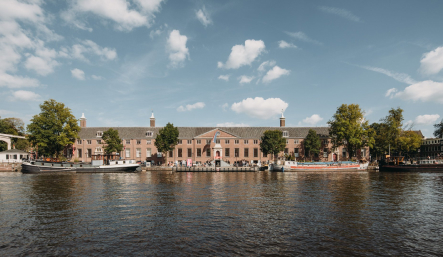
Today, H’ART Museum celebrates a milestone moment in the installation of Chez Matisse. Masterpieces from Centre Pompidou. This major autumn exhibition in Amsterdam focuses on the impressive and multifaceted oeuvre of Henri Matisse (1869–1954), one of the most influential artists of the 20th century.
Featuring 80 works from the collection of Centre Pompidou, the exhibition explores Matisse’s work in relation to that of artists such as Barnett Newman, Mark Rothko, Pablo Picasso and Sonia Delaunay. The exhibition demonstrates Matisse’s unparalleled ability to challenge and redefine the boundaries of painting, and his profound influence on generations of artists. Chez Matisse offers a glimpse into a beloved collection from Centre Pompidou. The world-renowned museum in Paris holds one of the most comprehensive collections of Matisse’s work in the world. This exhibition is only the third major retrospective of Matisse’s oeuvre ever presented in the Netherlands. It will be on view from Saturday, 3 October 2026 through Sunday, 14 February 2027.
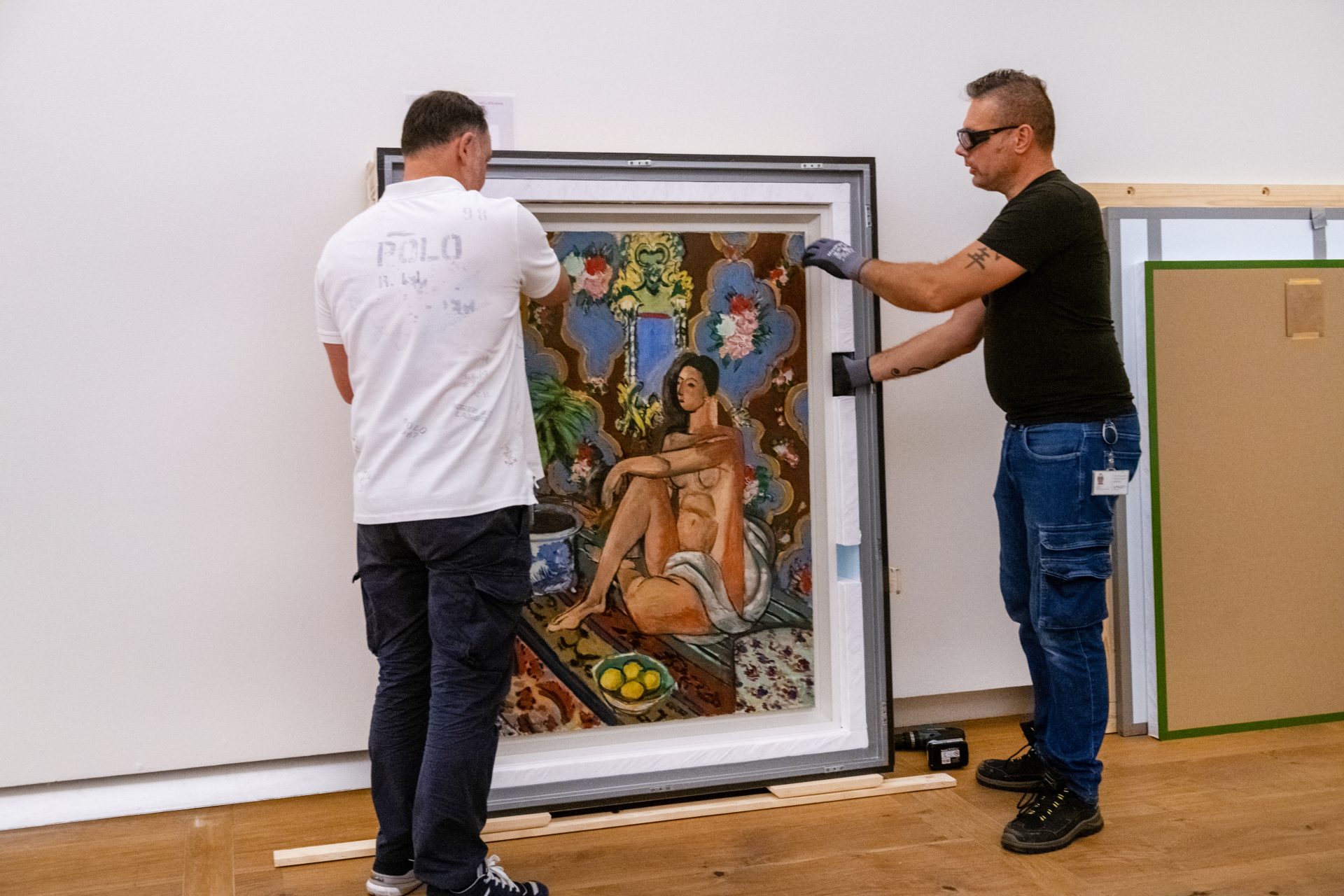
One of the exhibition’s key works took its place on the wall today: Figure décorative sur fond ornemental (Nice, 1925–1926). Nearly 100 years old, the painting marks a turning point in Matisse’s artistic development. Here, he radically experiments with the relationship between figure, space and decoration. The woman is depicted almost like a statue, blending into an exuberantly patterned background. The boundary between figure and décor consequently seems to dissolve. In doing so, Matisse not only challenges traditional notions of space and form, but also the boundary between painting and decoration. His intensely decorative style attracted considerable criticism at the time. In modern art of the period, the ‘decorative’ was all too readily dismissed as superficial.
A Closer Look at the Odalisque
The woman depicted in the painting is an odalisque, a term originally used for a chambermaid in the household of a Turkish sultan. In Western art with Orientalist themes, these female figures are often portrayed nude. Matisse, in turn, frequently depicted odalisques as objects within a still life. The artist once famously said: ‘I paint odalisques because I want to paint nudes.’
Today, the seemingly superficial representation and submissive poses of these women rightly raise questions. Artist Zoulikha Bouabdellah (1977) reflects on this topic in the exhibition catalogue and in the exhibition itself. Matisse lived during a period of major feminist movements, but Bouabdellah asks: why, then, ‘does Matisse remain faithful to his odalisque’? She argues that Matisse’s odalisques are not merely an expression of the male gaze. His paintings also invite a broader reflection on the ways in which the female body has been represented in art: as an object of beauty and desire, but also as a form of decoration and abstraction.
Matisse colours Amsterdam
The exhibition promises an exceptional introduction to the work of Henri Matisse. His teacher, Gustave Moreau (1826–1898), recognised his potential early on, telling his young pupil: ‘You are going to simplify painting.’ In the years that followed, Matisse reinvented painting through his liberated use of colour. Chez Matisse traces the remarkable development of his oeuvre, in which artistic innovation went hand in hand with his personal and artistic search.
From his early self-portrait of 1900 to his later paintings and iconic cut-outs (presented in printed form in the exhibition), the exhibition reveals an oeuvre defined by freedom, innovation and simplicity. Matisse was not only a painter, but also a sculptor, draughtsman, printmaker, and book illustrator. It is precisely the breadth of his practice that reveals his continual experimentation with form, colour and materials. Unlike his friend and rival Pablo Picasso, Matisse developed his style gradually and consistently, driven by the conviction that true simplicity can only emerge through years of experimentation and refinement.
Discovery, Dialogue and Influence
The exhibition also explores the artistic exchange between Matisse, his friends and contemporaries, including Pierre Bonnard (1867–1947), Albert Marquet (1875–1947), Kees van Dongen (1877–1968), Natalia Goncharova (1881–1962), Georges Braque (1882–1963), Sonia Delaunay (1885–1979), Le Corbusier (1887–1965) and Jean Pougny (1890–1956). Long after his death, Matisse continues to inspire leading artists, including Mark Rothko (1903–1970), Barnett Newman (1905–1970), Anna-Eva Bergman (1909–1987), Françoise Gilot (1924–2023), Pablo Picasso (1921–1975), Ellsworth Kelly (1923–2015), Shirley Jaffe (1923–2016), Raymond Hains (1926–2005), Brice Marden (1938–2023), Daniel Buren (1938) and Zoulikha Bouabdellah (1977).
This exhibition is made possible thanks to the indispensable support of founder VriendenLoterij; partners Aegon, ELJA Foundation, the City of Amsterdam and ABN AMRO; the funds Blockbusterfonds, FONDS 21, the Cultuurfonds, the Mondriaan Fund, Zabawas and JK Stichting; as well as the H’ART Museum Circle and Friends.

About Centre Pompidou
Since 1977, Centre Pompidou has been a place of living, engaged culture, a multidisciplinary center deeply rooted in society and open to the world. In 2025, it embarked on a true metamorphosis, allowing it to remain active and dynamic throughout its renovation and until its reopening in 2030. Through the Constellation program, the spirit of Centre Pompidou is embodied in numerous partner locations in France and abroad, including Centre Pompidou-Metz, the Grand Palais, and soon Centre Pompidou Francilien in Massy.
For the past fifteen years, Centre Pompidou has strengthened its international presence through traveling exhibitions, exceptional loans, and lasting collaborations. This approach aims to disseminate its collections, share expertise, and create dialogues between artistic scenes, while contributing to French cultural diplomacy. The opening of Centre Pompidou around the world plays a key role in this strategy. Following Malaga in 2015, Shanghai in 2019, and Seoul in May 2026, a new international location will open in Brussels in November 2026, marking an important step in the institution’s history. Centre Pompidou favors tailored and evolving collaborations, confirming its role as a key player in the global circulation of art and museum practices.
Note to the editor
Photo credit:Henri Matisse, Decorative Figure On Ornamental Background, [winter 1925–1926]. Collection Centre Pompidou. Photographer: Janiek Dam.
Press opening invitation: Thursday, October 1 at 10:00 AM. Please register via pressoffice@hartmuseum.nl
Images can be downloaded at hartmuseum.nl/press. For special image requests, please contact us at pressoffice@hartmuseum.nl
Contact H’ART Museum
Press & Marketing Communications Department
Madeline van Vliet and Paul Somers
+31 (0)20 626 81 68 | pressoffice@hartmuseum.nl
www.hartmuseum.nl/pers/
Contact Centre Pompidou
Communications and Digital Media Department
International Press Officer
Mia Fierberg
Mia.fierberg@centrepompidou.fr